
Scratching in walls at night is almost always an animal that is awake while you are trying to sleep. In Northern Connecticut that usually means mice, flying squirrels or, less often, rats, bats or a raccoon. The time you hear it, where it is in the house and what it sounds like will usually tell you which one. That matters, because each animal needs a different fix, and the damage keeps building while you wait to find out. This guide covers how to tell them apart, what waiting costs, what you can safely check yourself and what to leave alone.
What the time of night tells you
Start with the clock. For two or three nights, write down when the noise starts, when it stops and which wall or ceiling it comes from. That short record is the most useful thing you can hand to whoever inspects the house.
- Soon after the house goes quiet, on and off until morning: most often mice. They are active at night and travel the same routes inside walls again and again.
- Late at night, from high in the wall or the ceiling, sometimes several animals at once: often flying squirrels. They are nocturnal and live in groups, so most people never see them.
- Around dusk and again before dawn, near the roofline or chimney: possibly bats moving in and out of a roost.
- Early morning and late afternoon, not the middle of the night: more likely gray squirrels. CT DEEP notes that gnawing and pattering in early morning or daylight hours usually signals squirrels.
- Heavy thumping or slow walking overhead at night: a larger animal such as a raccoon, usually in the attic or a chimney, not inside a wall.
What each animal sounds like inside a wall
Timing narrows it down. The sound itself helps with the rest.
- Mice: light, quick scratching and scurrying, and now and then a faint gnawing. It often comes from low in the wall, behind the kitchen, or along the ceiling between floors. Droppings are about the size of a grain of rice.
- Rats: slower and heavier than mice, with louder gnawing. More common low in the house: basements, crawlspaces and the walls just above them.
- Flying squirrels: scurrying, rolling and soft thumps late at night, usually high up. If it sounds like more than one animal, it probably is.
- Bats: light scratching or fluttering and high squeaks, close to the roofline, around dusk and dawn.
- Gray squirrels: fast, noisy running and scratching in daylight. Sometimes one falls into a wall cavity from the attic and scratches without stopping because it cannot climb back out.
Sound is a strong clue. It isn’t proof. Walls and ceilings carry noise, so a mouse on a ceiling panel can sound much bigger than it is. Droppings, entry holes and rub marks confirm what the sound suggests, and that is what an inspection is for.
Why scratching in walls at night starts when the weather turns
This noise is most common from late fall on. As nights get cold around Enfield, Windsor, Suffield and the rest of Hartford County, animals that spent the summer outdoors look for somewhere warm and dry. A house leaks warm air at the roofline, around pipes and wires, at the garage door and along the top of the foundation, and animals follow that warm air to the gap it comes from.
A mouse needs a gap only about a quarter inch wide. Flying squirrels and bats use openings at the roofline that are too small to notice from the ground. Older homes with fieldstone or block foundations, additions, dormers and several rooflines have more of these gaps, but newer houses have them too.
Once an animal is in, it has no reason to leave before spring. A noise that starts in November is rarely a visitor passing through.
What waiting costs you
It is tempting to give it a few weeks and see if the noise stops. Here is what goes on inside the wall in the meantime.
- Chewed wiring. Rodents and squirrels gnaw all the time, and electrical cable is in their path. Chewed wire insulation is a known fire risk, and you cannot see it behind drywall.
- Soiled insulation. Droppings and urine build up where the animals nest and travel. Insulation gets flattened, shredded and dirty, and it stops doing its job.
- Bigger holes. Squirrels keep chewing at the edges of an opening, so a small gap gets wider every week. A wider gap lets in water and other animals.
- More animals. Mice breed indoors through the winter, and flying squirrels gather in groups. The problem you have in February is seldom the same size as the one you had in November.
- A harder cleanup. The longer animals live in a wall or attic, the more there is to remove and disinfect once they are out.
None of this shows from inside the room. The scratching is the only warning most people get.
What you can check yourself
You don’t need to open a wall or climb on the roof. These checks are safe and they make an inspection faster.
- Keep the log. Time, place and type of sound for two or three nights.
- Look for droppings with a flashlight: under the kitchen sink, behind the stove, along basement walls, on the sill at the top of the foundation and in the attic near the hatch. Don’t sweep or vacuum dry droppings. Wear gloves, wet them with disinfectant first, then wipe them up.
- Walk around the outside in daylight. Look up at the corners where the roof meets the walls, at vents and at the chimney. Look for chewed wood, bent screens, gaps and dark greasy stains around small openings.
- Watch the roofline at dusk for fifteen minutes. Bats leaving a gap are easy to spot against the sky.
- Check the garage. Close the door and look for daylight under it and at the corners. An attached garage is a common first stop for mice.
- Look where pipes and wires enter the house, including the gas line, air conditioning lines and the dryer vent.
Take photos of anything you find. Don’t close anything up yet.
What not to do
- Don’t seal the hole you found. If animals are inside, closing their exit traps them in the house. They will chew a new way out, sometimes into the living space, or die in the wall.
- Don’t put out poison. A poisoned mouse often dies inside the wall, and then you have a smell you cannot reach. Rodent poison is also a risk to pets and to the hawks, owls and foxes that eat mice. We do not use second-generation anticoagulant rodenticides. Our post on why mice return explains what we do instead.
- Don’t count on mothballs, peppermint oil or plug-in sound devices. They do nothing about the gap the animal is using, so the animal stays.
- Don’t handle a bat. Bats are protected in Connecticut and are removed only by exclusion, which means letting them leave and then sealing the gaps. If a bat may have touched someone, or was found in a room where someone was asleep, contact your doctor or the CT Department of Public Health before it is released.
- Don’t cut into the wall to find the source. The animal moves, and the opening it uses is almost never where the noise is.
How we find the way in and close it
Our approach is mechanical first, chemical last. For noises in walls that means three steps.
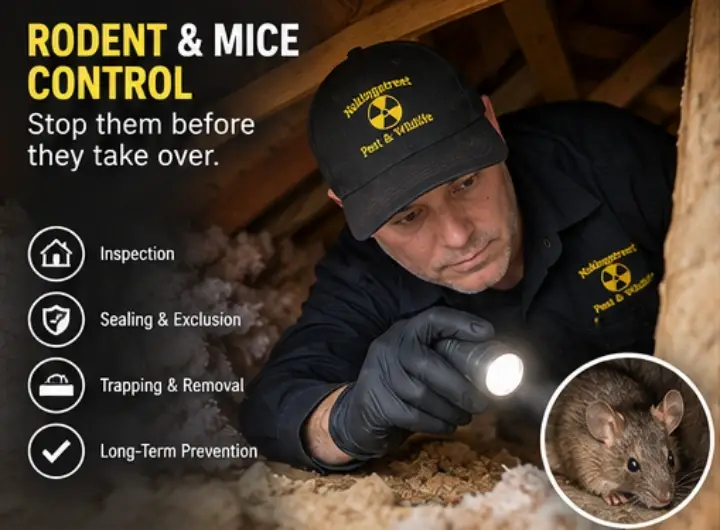
Inspect the whole structure. A forensic inspection covers the house from the roofline to the foundation, inside and out. We are looking for every opening, not only the obvious one, and for the droppings, rub marks and nesting that show which animal it is. Your log of times and places tells us where to start.
Get the animals out in a way that fits the animal. Mice and rats are trapped; see rodent control. Squirrels are removed with one-way doors or traps after we check for young; see squirrel removal. Bats are excluded, never trapped, and the timing is fixed by the season: we do bat exclusions in the warmer months, outside June and July, when pups cannot fly yet. If the noise turns out to be bats in winter, we will tell you so and plan the work for the right window; see bat removal.
Seal every opening. This is the step that stops the noise coming back. Gaps are closed with steel mesh, hardware cloth and metal flashing that animals cannot chew through; see exclusion and sealing. If we find a building problem you need to know about, such as rotted trim or a failed vent, we will tell you, even when it is not what you hoped to hear.
Hearing scratching in the walls at night? Call Nukingstreet Pest & Wildlife Control at (866) 553-5538 to book an inspection. We work from Enfield and serve homes across Hartford County, including Windsor, South Windsor, Suffield and Simsbury.
FAQ
What animal makes scratching noises in walls at night?
In Northern Connecticut it is most often mice. Flying squirrels are a common cause when the noise is high in the wall or ceiling late at night. Rats, bats and raccoons are less common. Gray squirrels are active in daylight, so noise in the middle of the night is rarely them.
Will the scratching go away on its own?
Usually not before spring, and often not then. An animal that has found warmth and shelter stays, and the opening it used stays open for the next one. A quiet spell usually means the animals have moved to another part of the house, not that they have left.
Can mice in the walls get into the rooms?
Yes. Mice follow pipes and wires, and they come out under sinks, behind the stove and through gaps around radiator and heating pipes. Droppings in a kitchen cabinet are often the first sign that the scratching in the wall has reached the room.
Should I seal the hole if I find where they are getting in?
Not yet. Sealing with animals still inside traps them in the house. The order is: identify the animal, get every animal out, then seal every opening. With bats, the season decides when that can be done.
Is it safe to wait until spring?
Waiting gives the animals a winter of chewing, nesting and breeding inside the walls. An inspection now tells you what it is and how urgent it is. Sometimes, as with bats in winter, the right plan is to wait for the proper season, but that should be a decision you make knowing what is in the wall.