

School Pest Control CT: IPM Programs for Safe Learning
By Nukingstreet Pest & Wildlife Control LLC Editorial Team · Updated 2026-08-07
School and daycare IPM programs combine sanitation, exclusion, and habitat modification with pesticide use only as a last resort, protecting children who face higher pesticide sensitivity. Nukingstreet Pest & Wildlife Control LLC brings that same discipline to schools and daycares.
Key Takeaways
- California Department of Pesticide Regulation offers free online IPM training for school and child care center staff.
- IPM programs use sanitation, habitat modification, exclusion, repellents, pheromones, and pesticides to control pest problems effectively.
- Schools and child care centers use pesticide products including disinfectants, insecticides, and herbicides on job sites.
- IPM philosophy focuses on preventing and reducing pest problems while implementing reduced-risk pest management methods.
Why Does School Pest Control Demand Different Standards?
Classrooms and daycare centers hold higher stakes than an ordinary home or office. Young children face greater risk from pesticide exposure than adults. school pest control ct providers must operate under a stricter safety margin than a standard residential job. Nukingstreet, based in Enfield, CT, extends professional pest management standards to schools and daycares across Northern CT and Western MA, ensuring strict adherence to safety protocols.
Much of the pest control industry still reaches for chemicals first and prevention second. That habit, common across the trade, becomes far riskier inside buildings where toddlers crawl on floors and grade-schoolers eat lunch at shared tables. A facility manager weighing vendors should ask how a company handles infestations before spraying — not after.
What makes a pest program safe for a classroom setting?
Safety starts with restraint. A qualified program treats only the confirmed problem area, avoiding blanket applications of whatever product costs the least. This targeted approach reduces chemical load throughout the building while still resolving the underlying infestation.
Why does prevention matter more in child-occupied buildings?
Prevention limits exposure before it ever becomes a risk. Effective daycare pest prevention relies on sealing entry points, removing food sources, and monitoring activity rather than reacting only once pests appear.
A sound framework for ipm for schools typically includes:
- Targeted treatment instead of routine blanket spraying
- Root-cause identification, not just symptom control
- Reduced chemical exposure for children, staff, and visitors
- Ongoing monitoring to catch problems early
Facilities that hold vendors to these standards protect students without compromising on results.
What Exactly Is Integrated Pest Management for Schools?
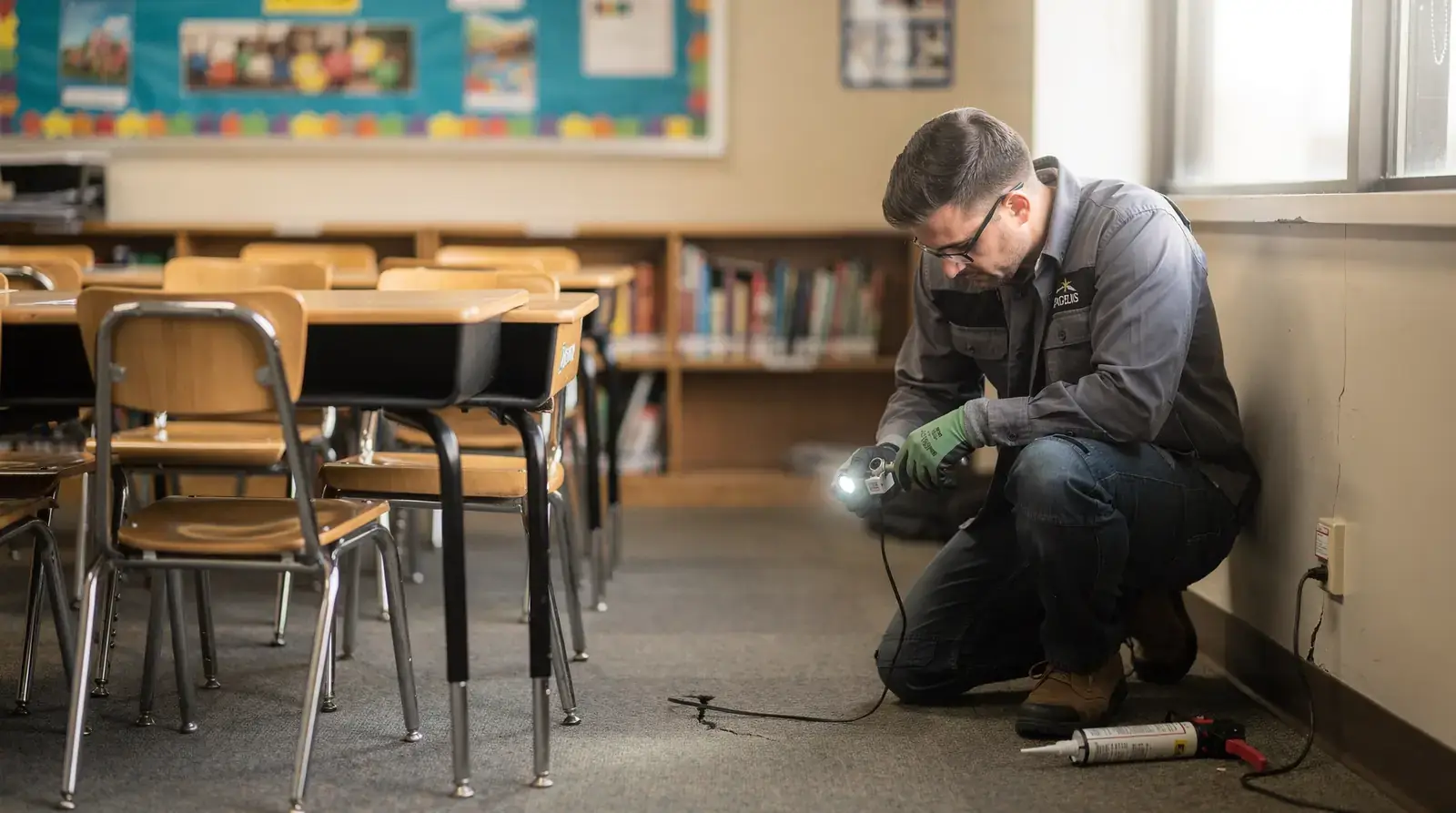
Integrated pest management, or IPM for schools, means preventing, reducing, and eliminating infestations through reduced-risk methods instead of routine chemical spraying. Facility managers who adopt this philosophy replace scheduled treatments with a strategy built on prevention first, chemicals last. That shift matters most in buildings full of children. Exposure risk carries higher stakes than in a typical office or warehouse.
Real IPM programs rarely rely on a single tactic. Effective plans layer several tools together, adjusting the mix as conditions change on campus.
- Sanitation — removing food debris, standing water, and clutter that attract pests
- Habitat modification — closing off nesting sites and correcting moisture problems
- Exclusion — sealing entry points around doors, vents, and utility lines
- Repellents and pheromone tools — disrupting pest behavior without broad chemical exposure
- Pesticides — used sparingly, only when other methods fall short
This layered approach forms the backbone of dependable school pest control ct administrators can defend to parents, staff, and health inspectors alike.
How does this differ from ordinary pest spraying?
Ordinary spraying targets what’s visible and stops there. Nukingstreet’s approach digs deeper, tracing an infestation back to its root cause rather than masking symptoms with a chemical barrier. That root-cause focus prevents the same pest problem from resurfacing month after month.
Why does IPM matter for daycare campuses specifically?
Young children spend hours crawling, napping, and eating close to floors and play surfaces, raising the stakes of any chemical misstep. Sound daycare pest prevention leans on exclusion and sanitation before pesticides ever enter the conversation. Nukingstreet extends that same caution outdoors, protecting pollinators, wildlife, and the ecosystems surrounding playgrounds and school grounds. Not just the interior classrooms.

What Do Connecticut and Massachusetts Rules Require?
Massachusetts law sets the clearest bar: daycare and school administrators must keep a written IPM for schools plan on file with the Department of Agricultural Resources. Connecticut facilities face similar expectations under the Healthy Schools framework, though enforcement paths differ slightly between the two states. Documentation is not optional paperwork — it’s the foundation that inspectors, parents, and insurers expect to see.
Notification rules carry equal weight. Facilities must give parents and staff standard written notice before any outdoor pesticide application on school property. Waiting until treatment day is too late; the notice has to go out in advance, on record.
Are there exceptions for pest emergencies?
Yes, but narrowly. Emergency infestations — a wasp nest near a playground, for example. May qualify for an exemption from the standard notification timeline. That exemption isn’t automatic, though. It comes only through the local Board of Health or the state Department of Agricultural Resources, not from the facility itself or its pest control provider.
What should administrators keep on file?
A defensible daycare pest prevention file usually includes:
- A written IPM plan naming target pests, prevention steps, and monitoring frequency
- Records of every pesticide application, indoor and outdoor
- Copies of parent and staff notifications, dated and archived
- Any emergency exemption approvals, with the issuing agency named
Facilities that skip this documentation risk citations during licensing reviews. Lose credibility with parents asking direct questions about chemical use near children.
Building compliant records isn’t a one-person job. Most administrators don’t have time to track evolving state requirements on top of everything else on their plate. Nukingstreet Pest & Wildlife Control, based in Enfield, CT, works alongside schools and child care centers across the region to structure school pest control CT programs around documentation from day one. Treatment logs, notification templates. Exemption paperwork included — so compliance never becomes a scramble.

Why Are Children More Vulnerable to Pesticides?
Small bodies absorb chemical exposure differently than adult bodies, and developing organs process toxins less efficiently. Pesticides count among the substances specifically engineered to kill, control, or repel pests. A design purpose that demands extra caution anywhere young children eat, nap, or play. Careless application in these environments creates unnecessary risk rather than solving a pest problem.
Misused pesticide products may cause serious injury, which is precisely why classrooms and daycare centers require restraint over routine, calendar-based spraying. A facility that treats on a fixed schedule regardless of actual pest activity exposes children to chemicals they never needed. Effective school pest control ct providers avoid that pattern entirely, favoring inspection-driven decisions over blanket applications.
What Makes a Facility’s Pest Program Child-Safe?
A child-safe program starts with a health-conscious philosophy built for families, cancer survivors, and pet owners who worry about chemical residue. Nukingstreet applies that same standard to educational facilities, treating classrooms with the same caution owners bring to their own homes.
Facility managers evaluating a provider should look for:
- Root-cause investigation before any treatment begins
- Reduced reliance on preventive chemical applications
- Documentation suited to regulatory review
- Willingness to explain methods in plain language
Does Prevention Reduce the Need for Chemicals?
Yes. A proactive standard focused on root causes cuts down on the routine chemical applications common in older-style facility contracts. Instead of masking symptoms with a spray, technicians address the conditions. Gaps, moisture, food sources — that invite pests in the first place.
This approach forms the backbone of sound daycare pest prevention and reflects the broader philosophy behind ipm for schools: manage the environment first, and reserve chemical tools for situations that genuinely require them. Children benefit most when pest control starts with prevention, not pesticide.
What Does Mechanical-First Pest Control Look Like?
Mechanical-first pest control means exclusion, sealing, trapping, and sanitation come before any product touches a classroom surface. Chemicals become a last resort, not a default. For facility managers weighing school pest control ct options, this order of operations determines how safe a building stays for children with developing immune systems.
Nukingstreet’s approach traces back to its origins as a single-technician operation serving multifamily properties. That founding conviction — that the pest control industry could be done better — still shapes every appointment. The company grew into a full-service pest and wildlife control provider without abandoning the discipline that built it.
Who inspects the property before treatment begins?
Owner Jeffrey Davis holds the Associate Certified Entomologist designation, a credential that signals entomology-level training rather than basic applicator licensing. That expertise matters most in daycares and schools, where pest identification errors lead to unnecessary chemical use. Davis’s background allows technicians to distinguish a minor ant trail from a structural entry point before reaching for any product.
Why does one technician per truck matter for daycare pest prevention?
The one-technician, one-truck model reflects a deliberate refusal to rush. Technicians work each site fully rather than splitting attention across overlapping jobs, which supports thorough daycare pest prevention during inspections. This structure gives kitchens, nap rooms, and storage closets the same careful review, not just the areas where pests were last spotted.
Targeted service replaces blanket spraying with a room-by-room strategy. Rather than fogging a facility with whatever product is cheapest, technicians identify the specific pest and the specific entry point. That precision forms the backbone of effective ipm for schools, where minimizing chemical exposure protects children without compromising results. Facility managers get documented, defensible pest management — not guesswork.
What Daycare Prevention Steps Actually Work?
Physical exclusion stops more pests than any spray ever will. Door sweeps and sealed gaps around foundations, windows, and utility lines block ants, rodents, and cockroaches before they set foot inside a classroom. This structural approach forms the backbone of daycare pest prevention. It works because pests can’t infest what they can’t reach.
Sanitation matters just as much as sealing. Removing food debris, standing water, and clutter takes away the shelter pests need to survive. Together, exclusion and sanitation form the first line of defense under IPM for schools, cutting pesticide dependence rather than masking problems with chemical treatments.
Nukingstreet’s inspection process centers on root-cause detection. A single mouse dropping near a supply closet or a few ants near a snack station signals a bigger issue underneath. Catching those early clues prevents a minor sighting from turning into a building-wide infestation that disrupts a full classroom.
Why does exclusion work better than spraying for daycare pests?
Sealing entry points removes the pathway pests use to reach food and water sources indoors. Spraying only treats pests already present, while door sweeps and sealed gaps keep new populations from ever establishing themselves.
Is eco-friendly prevention safe near outdoor play areas?
Outdoor play spaces call for school pest control ct methods that protect pollinators. Local wildlife along the fence line and garden beds. An environmentally responsible standard keeps beneficial insects and neighborhood ecosystems intact while still denying pests entry to the building.
Facility managers get the strongest results by combining these approaches:
- Structural sealing at doors, windows, and utility penetrations
- Removal of food, water, and clutter that shelter pests
- Early inspection focused on root causes, not just visible symptoms
- Outdoor treatment choices that protect pollinators near play areas
How Does AI Monitoring Support School IPM?
Electronic sensors track pest activity around the clock, alerting technicians before a minor sighting turns into an infestation. Continuous data collection catches early signs that a monthly walkthrough might miss entirely. For administrators managing school pest control ct requirements, that early-warning capability closes the gap between scheduled inspections.
Nukingstreet built its entire business on the belief that pest control could be done differently — proactive, not reactive. That founding conviction, rooted in the company’s early years serving multifamily properties, now extends into remote monitoring technology. Rather than waiting for a teacher or kitchen staffer to spot droppings or damage, sensors flag activity the moment it starts.
Why does proactive monitoring matter for daycare pest prevention?
Young children spend hours on floors, near baseboards, and in kitchen and nap areas where pests often hide first. Daycare pest prevention depends on catching problems at the source, not after an infestation spreads through a classroom. Root-cause detection, a standard Nukingstreet applies across every service line, allows technicians to intervene at the earliest possible stage rather than treating symptoms after the fact.
What does this look like in daily facility operations?
Monitoring data feeds directly into a facility’s broader pest management plan, supporting the documentation many programs need for IPM for schools. Benefits include:
- Continuous activity tracking between technician visits
- Earlier intervention that reduces reliance on chemical treatment
- Data-supported records for facility safety files
- Fewer surprise disruptions to classrooms and food service areas
Nukingstreet, headquartered in Enfield, CT, applies this monitoring-supported approach for school and daycare clients across Northern CT and Western Massachusetts. Facility managers gain a documented, technology-backed layer of protection that works quietly in the background. Long before staff or students ever notice a problem.
How Should Your School Start an IPM Program?
Successful programs begin with a mindset shift, not a spray schedule. Integrated pest management, often called IPM for schools, works as a pathway toward effective, sustainable pest control rather than a single fix or product. Administrators who treat it as an ongoing process — not a one-time inspection — see the strongest, longest-lasting results.
Facility managers evaluating a provider should look for four commitments guiding every service visit. Nukingstreet holds its technicians to these standards on every campus and daycare property served:
- Targeted treatment instead of a blanket spray of whatever product is cheapest
- Proactive inspection that finds the root cause, not just the visible symptom
- Health-conscious methods suited for children, staff, and pets on site
- Environmentally responsible practices that protect pollinators and surrounding ecosystems
That health-conscious standard matters most where vulnerable populations gather daily. Nukingstreet designs its daycare pest prevention protocols with the same care given to families, cancer survivors, and pet owners in residential settings. Children absorb chemicals differently than adults, so limiting exposure on campus isn’t optional. It’s foundational to responsible school pest control ct planning.
What does an IPM program actually look like day to day?
A working program combines regular inspection, sanitation review, exclusion repairs, and documented reporting. Technicians identify entry points, moisture issues, and food sources before reaching for any product. Treatment, when needed, targets the specific pest rather than the whole facility.
Who should schools call to get started?
Facility managers don’t need to build a program from scratch. Nukingstreet, based in Enfield, CT, works directly with schools and daycares to establish a compliant, fully documented pest management plan. One built around inspection records, prevention steps, and clear communication with staff and parents.
FAQ
What is Integrated Pest Management for schools and daycares?
IPM for schools prevents, reduces, and eliminates infestations through reduced-risk methods instead of routine chemical spraying. It layers sanitation, habitat modification, and exclusion together, using pesticides only as a last resort.
How does Nukingstreet approach pest control in child-occupied facilities?
Nukingstreet treats only confirmed problem areas rather than applying blanket sprays throughout the building. This targeted approach, serving Northern CT and Western MA from its Enfield, CT base, reduces chemical load while resolving the underlying infestation.
Why does prevention take priority over pesticide use in schools?
Prevention limits children’s exposure before it becomes a risk, given their higher pesticide sensitivity compared to adults. Sealing entry points, removing food sources, and ongoing monitoring catch problems early instead of reacting after pests appear.
Facts
- Nukingstreet Pest & Wildlife Control, LLC is located in Enfield, CT.