
Yellow jackets in the wall of a Connecticut house almost never survive the winter. The workers die once freezing weather sets in, the old nest is not used again, and only next year’s queens live on, somewhere else. So if you found the hole in fall, waiting is a real option. The two things that feel like quick fixes, sealing the hole and spraying into it, are the two that most often bring the wasps into your living room. This guide covers how they got in, what happens after a hard frost, whether they will be back and when removal is worth paying for.
Yellow jackets in the wall: the short answer
- Do not seal the hole while anything is still flying in or out.
- Do not spray a store product into it. The nest is rarely right behind the opening.
- The colony is annual. The workers die with freezing weather, and yellow jackets do not reuse a nest the next year.
- Wasps showing up indoors in late fall are almost always coming from a nest in the wall. It is unpleasant, and it is temporary.
- Seal the gap later, once all activity has stopped and before spring.
One caution before anything else. If anyone in the house has a sting allergy, stay away from the opening and from any wasps indoors, and treat signs of a serious reaction as an emergency.
How they got into the wall
Every yellow jacket nest starts with one queen. She comes out of winter shelter in spring and looks for a dry, protected cavity. In the wild that is an old rodent burrow or a hollow log. On a house it is a gap under a piece of siding, a missing bit of mortar, an opening where a cable or pipe passes through, or a crack at the corner of a window frame. Behind that gap is an empty space between the studs, which suits her well.
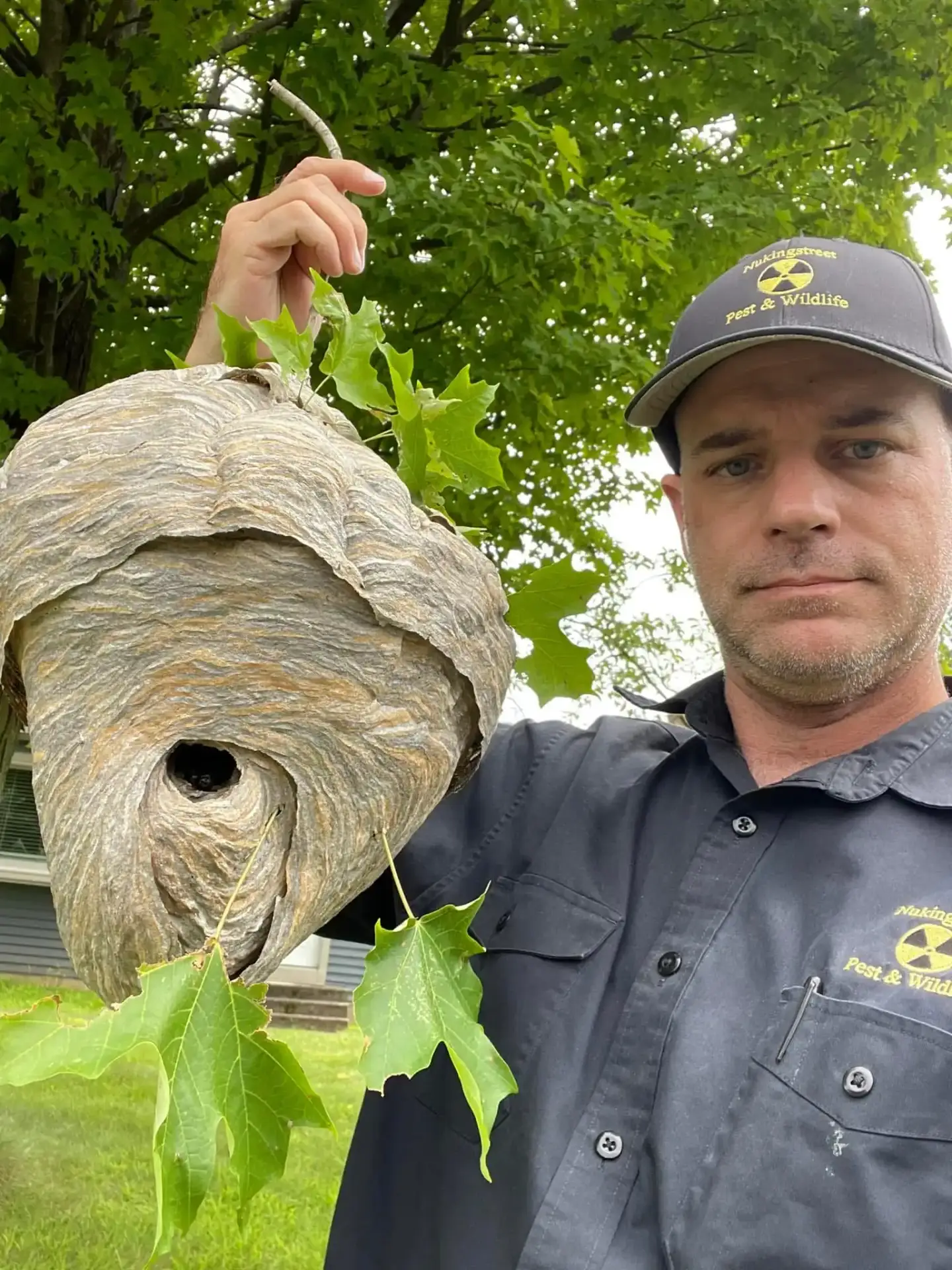
For the first weeks the colony is tiny and nobody notices. Through the summer the workers build layer after layer of paper comb inside the wall, and by late August a nest that began with one queen may hold several thousand workers. That is why so many homeowners in Enfield, Simsbury and West Hartford first see the traffic in September: a steady stream in and out of one small hole, often near a door or a deck.
Before you decide anything, make sure of what you are looking at. Yellow jackets are smooth and shiny with bright yellow and black bands. Honey bees are fuzzy and golden brown, and their colony does live through the winter, so everything in this article about waiting for frost does not apply to them. European hornets also nest in wall voids. They are larger, brown and yellow, and unusual in that they fly at night. If you are not sure, a clear photo from a safe distance is enough for us to tell you.
Why you should not seal or spray the hole
Sealing traps a live colony inside your house
Caulk or foam over the hole looks like the obvious fix. The problem is that the wasps are still alive on the other side, and they will look for another way out. Penn State Extension warns against closing the outside entrance of a wall nest for exactly this reason: yellow jackets that cannot leave may chew through the interior wall covering and come out in the living space. Drywall is not much of a barrier to an insect that makes paper out of wood.
Spraying rarely reaches the nest
The hole you can see is only the entrance. The nest itself may be several feet away, up or along the wall cavity. An aerosol sprayed into the opening tends to hit the wasps at the entrance and miss the comb, the queen and the brood. What you get is an alarmed colony at the one spot where you are standing, and often wasps pushed deeper into the wall, toward the room.
Spraying first also makes the job harder for whoever comes next. Jeff sees this often: the colony in the wall has already been sprayed by the time we get the call. With yellow jackets that mostly means a more defensive nest. If the insects turn out to be honey bees, it can rule out moving the colony alive. That is one more reason to identify them before doing anything.
What happens to yellow jackets in the wall after a hard frost
A yellow jacket colony runs on a one-year clock. In fall the nest produces new queens and males, which leave to mate. The males die soon after. The new queens each find a sheltered place to spend the winter alone. Back at the nest, food runs out and the cold arrives, and the workers and the old queen die. Iowa State University Extension puts it plainly: the nests are annual, the workers all die with freezing weather, and the nest is not reused the following year.
A nest inside a heated wall can lag behind the ones in the ground. Warmth from the furnace keeps a few workers alive longer than their cousins in the lawn. So in a Connecticut house the decline is gradual: heavy traffic in September, thin traffic in October, an occasional slow wasp at the hole in November, and then nothing.
There is a rare exception worth knowing about. Penn State notes that nests built in heated, insulated buildings occasionally survive a winter and keep growing into a second season. It is uncommon, but it is the reason to confirm the nest is dead before you close the hole, and not assume it.
Why yellow jackets show up indoors in late fall
This is the part that worries people most, and it has a simple cause. All summer the colony used a front door that led outside. When frost kills off the food supply and the yard turns cold, the remaining wasps start exploring the warm side of the wall instead. They find a gap around a light fixture, a window casing, a baseboard or an outlet, and they come out into the room.
Wasps that appear this way are usually sluggish and drawn to windows and lamps. They can still sting if the room is warm, so do not handle them. A vacuum or a fly swatter deals with the ones you see. They are not founding a new nest in your house, and they will not breed over the winter.
- Note where they are coming out. A piece of painter’s tape over that interior gap is a fair short-term stop.
- Leave the outside hole open until the nest is finished.
- Keep children and pets out of the room where they are appearing.
- If it is more than a few a day, or anyone in the house is allergic, that is the point to call.
A crackling or light scratching sound from the same stretch of wall or ceiling is worth taking seriously while the nest is active, because it can mean the wasps are working at the drywall. A soft or damp-looking spot on the wall or ceiling near the noise is a reason to call that day. If you hear noise in a wall and are not sure it is insects at all, our guide to scratching in the walls at night helps you sort out the likely causes.
Will they come back next year?
Not the same colony, and not into the same nest. The gap in your siding is still there, though, and so is the dry cavity behind it. Whatever made that spot attractive to one queen this spring will make it attractive to another next spring. An old nest site that is left open is an invitation.
That makes late winter the cheap moment to fix it. The order matters:
- Mark the hole now. Take a photo and note exactly where it is. In March you will not remember which clapboard it was.
- Confirm the nest is dead. On a mild afternoon, watch the opening for ten minutes. No traffic on several warm days means it is finished.
- Seal the entry point before queens start searching in spring.
- Check the rest of that wall. One gap usually has neighbours: other siding joints, utility lines, soffit corners and window trim.
This is the same thinking behind our exclusion and sealing work for mice and squirrels. Removing the animal or insect solves this year’s problem. Closing the way in is what stops next year’s. A forensic inspection finds the other openings on the house while we are there.
As for the dead nest, it is dry paper. In most cases it can stay inside the wall without causing trouble. It is worth removing when it has stained or softened the drywall, when it sits somewhere easy to reach such as an open attic or a crawl space, or when the wall is being opened anyway.
When removal is worth it
Waiting works when the season is nearly over. It is the wrong call in several situations:
- Someone in the home is allergic to stings. Do not wait on a live nest in the house.
- The entrance is beside a door, a walkway, a deck or a play area. Yellow jackets defend the space around their opening.
- Wasps are already coming inside in more than ones and twos.
- You can hear them in the wall or see the drywall changing.
- It is spring or summer. A nest found in June has months of growth ahead of it, and a small colony is far easier to deal with than a large one.
- The nest is in a house that stays warm all winter and activity has not stopped when it should have.
When we treat a nest, we start by confirming the species, because the plan differs for yellow jackets, hornets and bees. We treat early in the morning or at night, when the colony is inside and at rest. Then we look at why that spot was chosen, whether it was a structural gap, an open void or an old nest site, and tell you what to close so it is not used again. Our wasp, hornet and yellow jacket removal page explains the service in full.
Found a hole with yellow jackets going in, or wasps turning up at your windows this fall? Call Nukingstreet Pest & Wildlife Control at (866) 553-5538. We work from Enfield and cover Hartford County, including Simsbury, West Hartford, Canton and Windsor. If you are near our office, see pest control in Enfield.
FAQ
Do yellow jackets in the wall die in winter?
In almost every case, yes. The workers and the old queen die with freezing weather. A nest in a heated wall may hang on a few weeks longer than one in the ground, and on rare occasions a nest in a warm building survives, so confirm there is no activity before you seal anything.
Can I seal the hole once it gets cold?
Only after the nest is finished. Watch the opening on a few mild days. If nothing flies in or out, seal it, and do it before spring. Sealing while wasps are still alive inside can send them into the house.
Why are there wasps in my house in November?
They are most likely coming from a nest that has been in the wall since spring. With the cold outside and no food left, the last workers follow the warmth and find a gap into the room. It stops once the colony has died off.
Will yellow jackets reuse the nest in my wall next year?
No. Yellow jackets do not reuse an old nest. A new queen may choose the same cavity if the entry gap is still open, which is why sealing it over the winter matters.
I found one large, slow wasp indoors in late winter. Is the nest still alive?
Probably not. A single large wasp in late winter or early spring is often a queen that spent the winter in a sheltered part of the building and is waking up. Remove it, and take it as a reminder to seal gaps in the siding and around windows and pipes.