

Humane Geese Management CT for Commercial Properties
By Nukingstreet Pest & Wildlife Control LLC Editorial Team · Updated 2026-08-07
Effective humane geese management for commercial properties involves habitat modification, adjusting grass length, and installing deterrents. Nukingstreet Pest & Wildlife Control, LLC in Enfield, CT designs customized exclusion plans using visual and auditory deterrents that keep geese away without harming them, protecting lawns, walkways, and stormwater retention areas year-round.
Commercial properties require humane geese management because Canada geese are federally protected under the Migratory Birds Convention Act, making removal illegal without proper protocol. Nukingstreet Pest & Wildlife Control, LLC, based in Enfield, CT, provides compliant deterrent solutions that address property damage and safety hazards responsibly.
Commercial geese management combines habitat modification, humane deterrents, and legal compliance under the Migratory Birds Convention Act, which federally protects Canada geese from harassment without proper authorization. Effective programs address grass length, water access, and nesting sites while using visual and auditory deterrents. Professional assessment identifies why geese choose specific properties, then applies targeted, ethical solutions preventing property damage, slip hazards, and aggressive encounters.
Key Takeaways
- Canadian geese return to the same properties yearly during warm months, creating recurring management challenges.
- Geese cause property damage, create slip hazards, and display aggressive behavior toward commercial property visitors.
- Professional humane control methods protect facilities near bodies of water without harming bird populations.
- Nukingstreet Pest & Wildlife Control in Enfield, CT provides specialized commercial goose management solutions.
Why are geese taking over your property?
Open lawns near ponds draw geese because those settings deliver everything a flock needs: food, water, and clear sightlines to spot predators. Habit drives the behavior. Once geese find a location that meets those needs, they return to it season after season, often with larger numbers each year.
Commercial sites frequently check every box on a goose’s wish list. A corporate campus with a retention pond, a manicured lawn, and a wide-open parking lot resembles a natural habitat more than a business address. Golf courses, HOA common areas, and office parks with water features face the same pattern for identical reasons.
What makes a property attractive to geese?
Short grass paired with nearby water creates the strongest pull. Geese prefer unobstructed views across lawns so they can watch for threats while feeding. Mowed turf next to a pond checks that box perfectly.
Can removing the attraction stop the problem long-term?
Chasing geese off a lawn without changing the underlying conditions rarely works for long. A proactive assessment looks past the birds already on-site and identifies why the property keeps pulling them back. Pond edges without buffers, unrestricted lawn access, or a lack of large bird deterrents near feeding areas.
Property managers weighing solutions should consider the root causes below:
- Water access — unobstructed pond or retention basin edges
- Sightlines — short turf that lets geese watch for predators
- Food sources — fertilized lawns that produce tender, appealing grass
- Low disturbance — quiet zones with minimal foot traffic or noise
Effective geese management ct properties start with this kind of assessment, not a one-time chase-off. Identifying the draw is the first step toward humane goose control that actually holds.
What makes geese management legally complicated?
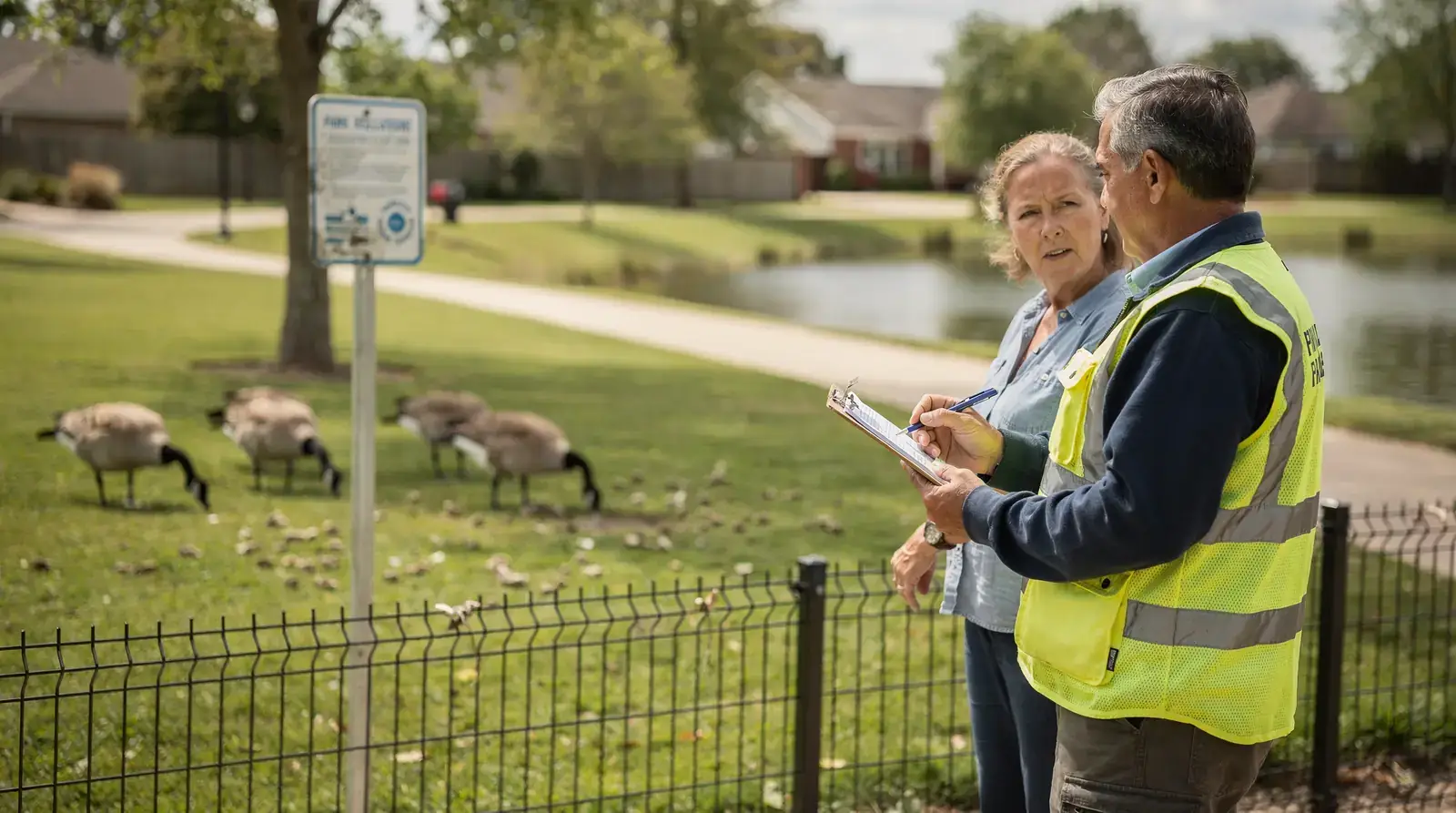
Federal law shields Canada geese from removal or harm, turning what looks like a simple wildlife nuisance into a compliance issue. Property managers who reach for DIY solutions risk violating protections that carry real legal consequences. That single fact reshapes every decision a commercial property or HOA makes about its grounds.
Because these birds carry federal protections, the goal shifts from elimination to management. Geese management CT property owners can pursue focuses on deterrence, habitat modification, and behavioral disruption rather than harming or relocating the animals. Cutting corners with unauthorized methods exposes a property to liability far beyond the cost of a droppings cleanup.
Can a property just remove geese on its own?
No. Removing or harming geese without proper authorization violates federal protections, regardless of how disruptive the birds have become. Property managers need approaches that stay within legal bounds while still solving the problem on the ground.
What does a legally sound goose control plan look like?
Effective humane goose control starts with assessing the property’s specific layout, water access, and food sources rather than applying a one-size-fits-all treatment. A blanket approach using whatever method is cheapest often fails and can invite legal exposure. A targeted plan typically includes:
- Site-specific assessment of nesting and feeding patterns
- Habitat modification to reduce food and water access
- Large bird deterrents suited to the property’s layout
- Ongoing monitoring to adjust the plan as geese behavior shifts
Every intervention should also meet an environmentally responsible standard, protecting pollinators, other wildlife, and the surrounding ecosystem while resolving the goose issue at hand.
What does humane goose control actually involve?
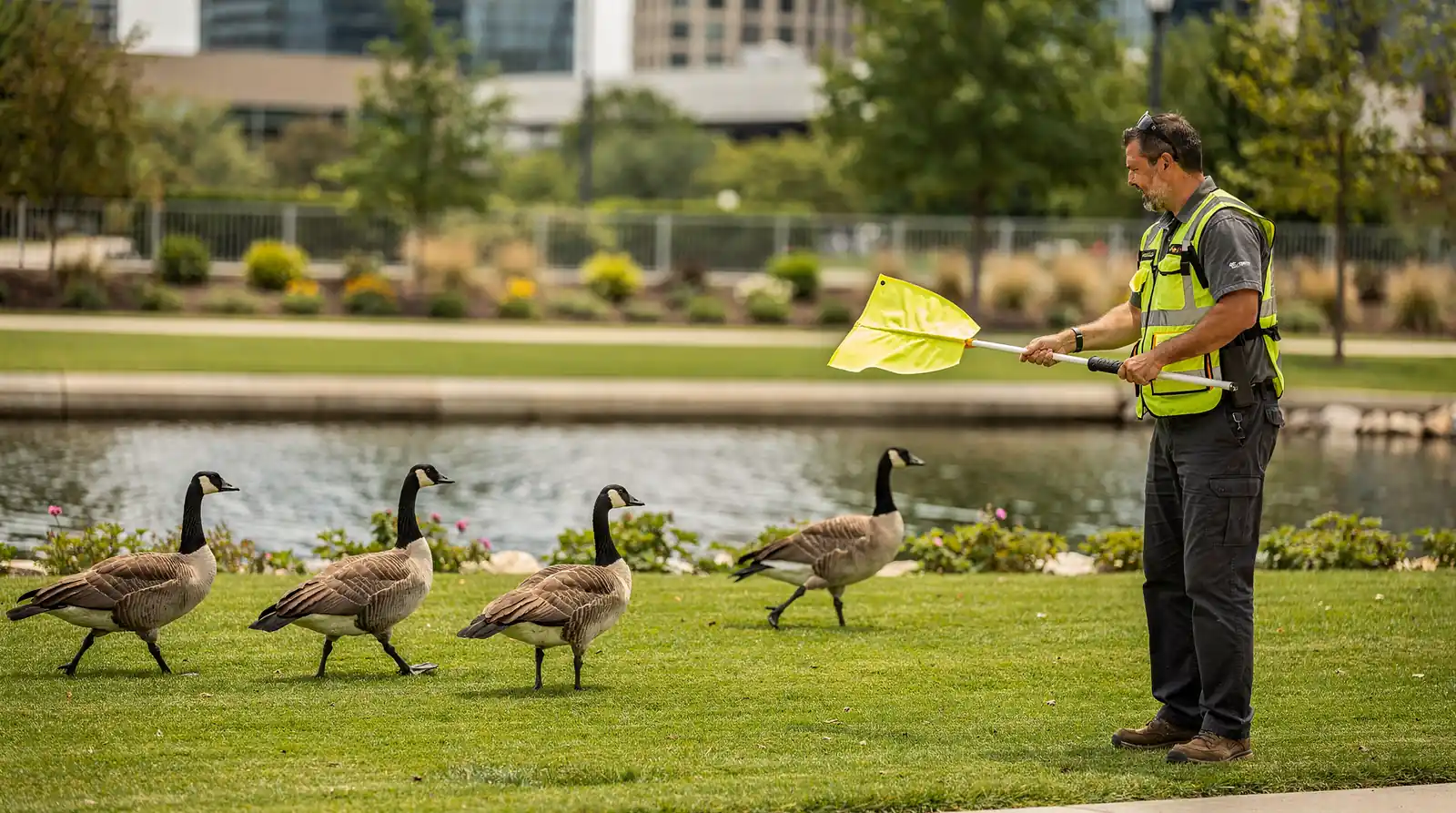
Trained deterrent methods, not harm, define effective goose management. Techniques focus on making a property unappealing to geese while leaving the birds unharmed and free to relocate. Property managers across Northern CT and Western MA rely on humane goose control because it protects both the flock and the business from legal exposure. Canada geese carry federal protection, and injuring them invites serious penalties.
Herding-based strategies have proven their worth for decades. Trained working dogs have supported businesses, corporate campuses, and golf courses with safe, non-lethal bird management since long before geese became a widespread commercial nuisance. That track record shows humane methods work at scale, not just on small residential lawns.
Is humane goose control safe for pets and families?
Yes — a properly designed program is built with sensitive households in mind. Service approaches that prioritize gentle, low-impact wildlife solutions matter most for families with young children, cancer survivors managing chemical exposure, and pet owners walking dogs near treated areas. Avoiding harsh deterrents or toxic repellents keeps the yard usable for everyone, human and animal alike.
Does one goose solution work for every property?
No single tactic fits every site. Effective geese management ct programs are tailored to the specific property, not applied as a one-size-fits-all fix. A short list of common tools includes:
- Habitat modification, such as adjusting turf or shoreline vegetation
- Trained dog patrols for herding geese off-site
- Visual and motion-based large bird deterrents
- Ongoing monitoring to catch new activity early
Matching the method to the site’s layout, water access, and foot traffic produces lasting results instead of a temporary fix that geese simply return to.

Which large bird deterrents actually work?
Effective large bird deterrents start with a site assessment, not a shopping list. A property manager who identifies why geese chose the location — open turf, easy water access, low predator risk. Can match equipment to the actual problem instead of guessing. That root-cause standard separates lasting results from temporary fixes.
Random deterrents placed without a plan rarely hold up. Geese habituate quickly to decoys or noise devices used alone, and property managers end up replacing equipment every season. A layered approach, chosen after evaluating traffic patterns and landing zones, performs far better over time.
Do decoys and noise makers stop geese on their own?
Decoys and noise devices help, but rarely work in isolation. Geese are intelligent birds that adjust to static or repetitive threats within days. Pairing visual and audio deterrents with landscape changes or barrier methods produces steadier results.
Why does deterrent placement matter more than the device itself?
Placement determines whether a deterrent interrupts the behavior causing property damage. Walkways coated in droppings become slip hazards for employees and visitors. Deterrents belong near entry points and grazing paths, not just open lawn. Benches, patios, and walkways also suffer wear from constant trampling and grazing, which means deterrents need to protect amenity areas directly, not just the perimeter.
Commercial and HOA properties see the strongest outcomes from combined strategies:
- Habitat modification — taller grass borders and reduced turf near water discourage nesting
- Barrier methods — fencing or grid systems along shorelines block easy access
- Trained deterrent programs — consistent, professionally managed presence that geese cannot easily ignore
Humane goose control built on this layered, root-cause approach protects walkways, amenities, and foot traffic without relying on a single quick fix.
How does Nukingstreet approach geese management ct?
Nukingstreet Pest & Wildlife Control, LLC operates out of Enfield, Connecticut, and serves property managers, HOA boards, and facility teams across Northern CT and Western MA. Geese management CT projects fall under the company’s wildlife division, which grew from a single technician and one truck into a full-service operation built on a simple conviction: pest and wildlife control could be done better than the industry standard of react-first, chemical-first service.
That growth shapes the standard applied to goose problems today. Every wildlife service, geese included, gets held to four benchmarks: targeted response, proactive root-cause correction, health-conscious methods, and environmental responsibility. Rather than a one-size-fits-all scare tactic, a plan for goose activity accounts for site conditions, flock behavior, and legal protections surrounding migratory birds.
What does humane goose control actually look like in practice?
Humane goose control focuses on discouraging return visits rather than harming the birds. Property teams can expect an assessment of nesting sites, water access, and food sources before any deterrent gets deployed.
Why do large bird deterrents matter for CT properties?
Large bird deterrents protect walkways, lawns, and water features from droppings, erosion, and aggressive nesting behavior. Consistent deterrent use also reduces liability exposure for HOAs and commercial sites.
Nukingstreet’s approach typically includes:
- Site evaluation of food, water, and shelter access points
- Habitat modification to reduce attraction
- Deterrent placement suited to the property layout
- Ongoing monitoring to catch new flocks early
This structure keeps solutions proactive instead of reactive, protecting grounds, guests, and employees while staying within federal wildlife protections.
Managing geese on commercial properties requires a thoughtful balance between effective control and humane treatment. By implementing habitat modification, exclusion techniques, and targeted deterrents, property managers protect their landscapes while respecting wildlife. Professional guidance ensures strategies align with local regulations and environmental standards. The result is a sustainable solution that safeguards your property and maintains ecological responsibility for years to come.
FAQ
Why do geese keep coming back to the same commercial property?
Geese return yearly to properties offering food, water, and clear sightlines to spot predators. Short grass paired with nearby ponds creates ideal conditions, and flocks often grow larger with each returning season.
Is it legal to remove geese from a commercial property?
Canada geese are federally protected under the Migratory Birds Convention Act, making removal illegal without proper protocol. Nukingstreet Pest & Wildlife Control provides compliant deterrent solutions that address property issues responsibly.
What does effective humane geese management actually involve?
Effective management combines habitat modification, humane deterrents, and legal compliance rather than simply chasing geese away. Professional assessment identifies why geese choose the property, targeting grass length, water access, and nesting sites.
Facts
- Nukingstreet Pest & Wildlife Control, LLC is located in Enfield, CT.