

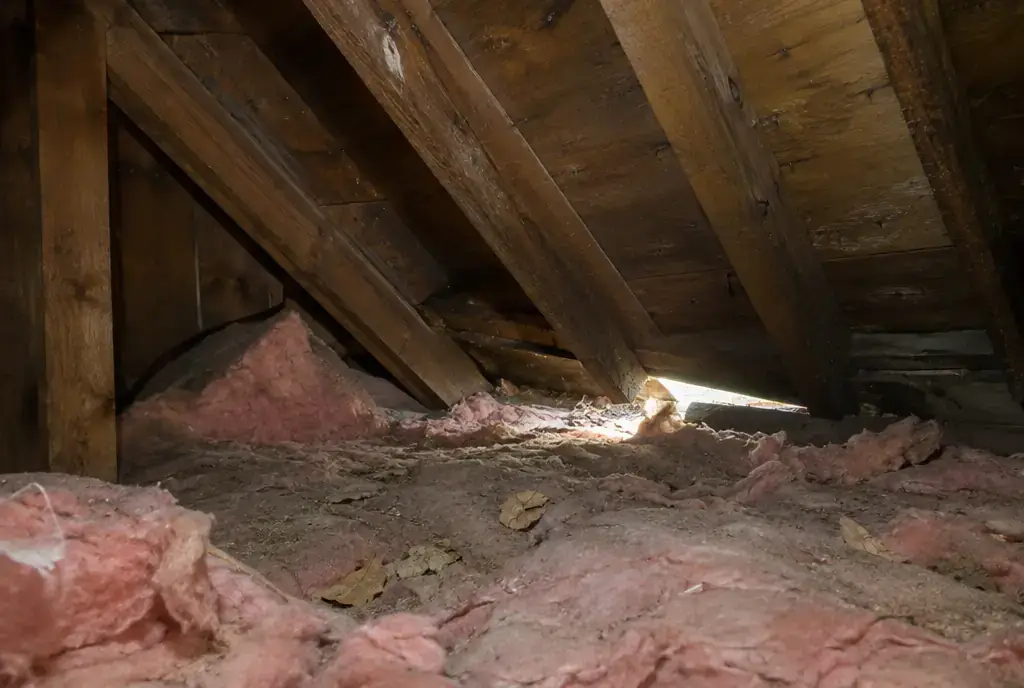
Flying squirrels in the attic are a different problem from gray squirrels in the attic, and the usual gray-squirrel fix does not solve it. Flying squirrels are active at night, they den in groups, and they come in through small holes high on the roofline. One trap and one patched hole will not end it. What works is finding every opening on the roof, letting the whole group leave, and then closing all of it. This guide explains how to tell which squirrel you have, why you never see them, and what a fix that lasts looks like for a home in Northern Connecticut.
How to tell flying squirrels from gray squirrels
Most people never see the animal, so the clock is the best clue. Gray squirrels are awake when you are. Flying squirrels are awake when you are trying to sleep.
- Time of the noise. Scurrying and scratching in the early morning and late afternoon points to gray squirrels. Noise late at night, well after dark, points to flying squirrels.
- How many animals it sounds like. A gray squirrel problem often sounds like one busy animal. Flying squirrels often sound like several at once: light running, rolling and soft thumps in different parts of the ceiling.
- What you see outside. With gray squirrels you will usually spot one on the roof going back to the same corner in daylight. With flying squirrels you see nothing, day after day, while the noise carries on at night.
- Size. The southern flying squirrel, the one found across Connecticut, is small. CT DEEP lists it at 8 to 10 inches long and roughly 2 ounces. That is far smaller than a gray squirrel, and it is why the holes they use are so easy to miss.
If you are not sure the noise is a squirrel at all, our guide to scratching in the walls at night covers how mice, bats and raccoons sound by comparison.
Why you never see them
Flying squirrels are nocturnal. CT DEEP notes that because of this they are seldom seen, even where they are common. They leave after dark and they are back inside before you are up.
They also do not need to cross your roof on foot. A flying squirrel has loose skin between its front and back legs and uses it to glide. According to CT DEEP, they may glide 150 feet or more from a height of 60 feet. A tall oak at the edge of the yard is close enough. The animal lands near the roofline, slips into a gap and is gone in a second or two.
This is why so many homeowners wait. No squirrel on the roof, no chewed hole they can see from the driveway, so it is easy to decide the noise is the house settling or a mouse or two. Meanwhile the attic is being used every night.
A group, not one animal
This is the fact that changes the whole plan. CT DEEP describes flying squirrels as highly sociable animals that feed and den together, especially during harsh weather. They are also active all year. They do not hibernate their way out of your attic.
So when the nights turn cold around Enfield, Simsbury, Canton and the rest of Hartford County, a warm attic does not attract one flying squirrel. It attracts the group. Homes on wooded lots with mature oaks, hickories and other nut trees are the most likely to have them, because that is the habitat these squirrels prefer.
A group living in one attic through the winter means more droppings and urine in the insulation, more nesting material pulled together, and more gnawing. Squirrels gnaw constantly, and chewed wire insulation is a known fire risk. If squirrels have been in the attic for a while, have an electrician check the wiring once they are out.
The gaps flying squirrels use
Gray squirrels tend to leave an obvious chewed hole. Flying squirrels often use openings that were already there. CT DEEP lists the usual places: small holes around dormers, ridge vents, eaves, attic vents and similar weak points.
On a typical house, that means:
- Corners where the fascia meets the soffit
- Roof returns and the joints where a dormer meets the main roof
- Gable vents with weak or rusted screens
- Ridge vents and gaps around the chimney
- The joint where an addition or a second roofline meets the original house
Two things make these hard to find. They are small, and they are high. Most cannot be judged from the ground, and a house with several rooflines can have a dozen candidates. There is almost never just one.
Why the gray-squirrel plan fails
The common plan for a gray squirrel goes like this: find the chewed hole, set a trap or a one-way door on it, catch the squirrel, patch the hole. With flying squirrels each step of that plan goes wrong.
- One trap catches one animal. The rest of the group is still inside. Catching one or two and hearing a quiet night or two is a false finish.
- Trapping alone does not hold. CT DEEP says plainly that trapping squirrels can solve a problem for a while but does not help in the long run, because other squirrels soon move in to replace the ones removed. If the openings stay open, the attic stays available.
- One patched hole moves the traffic. Close the one gap you found and the group uses the next one. You have not shut them out. You have changed which bedroom hears them.
- Sealing at the wrong moment traps animals inside. Flying squirrels are out at night and in during the day, so a hole patched on a Saturday afternoon has the whole group behind it. Trapped animals chew to get out, sometimes into the living space, or die in the attic.
- Young change the timing. CT DEEP notes that flying squirrels mate in late winter and again in summer, and that adults can cause severe damage chewing their way back in to reach their young. Shutting a mother out of a nest makes the damage worse.
Mothballs, sound devices and bright lights do not change any of this. None of them closes a gap.
What whole-roofline exclusion means
Our approach is mechanical first, chemical last. For flying squirrels there is nothing to spray and nothing to bait. The work is finding openings and closing them in the right order.
- Inspect the whole structure. A forensic inspection covers the roofline, vents, chimney and attic. We are looking for every opening, main and secondary, plus the droppings and nesting that confirm which animal it is. We also check for young.
- Close the secondary openings first. Every gap except the main entry is sealed with hardware cloth, metal flashing and steel mesh, which squirrels cannot chew back through.
- Let the group leave through one exit. A one-way door on the main entry lets the squirrels go out at night and stops them coming back in. Where a door is not the right tool, the squirrels inside are trapped. Any wildlife we remove is handled in accordance with state law.
- Confirm the attic is empty, then seal the last opening. The door comes off and that entry gets the same metal as the rest. See exclusion and sealing for how that work is done.
- Check the attic. We look at the insulation and wiring and tell you what we find, including when the news is that you need an electrician or a cleanup.
Tree work helps too. Branches within about 8 to 10 feet of the roof give any squirrel an easy route, so trimming them back is worth doing. With flying squirrels it is not enough alone, because they can glide in from much farther away. The sealed roofline is what keeps them out.
Hearing noise in the attic late at night? Call Nukingstreet Pest & Wildlife Control at (866) 553-5538 to book an inspection. We work from Enfield and provide squirrel removal across Hartford County, including Simsbury, Canton, Windsor and West Hartford. If you are close to our office, see wildlife removal in Enfield.
FAQ
How do I know if I have flying squirrels in my attic?
The strongest sign is noise late at night from high in the house, often from more than one animal, with no squirrels seen on the roof in daylight. An inspection of the roofline and attic confirms it.
Will flying squirrels leave the attic on their own?
Rarely. They are active all year and they den together in cold weather, so a warm attic is exactly what they want in a Connecticut winter. As long as the openings are there, they have no reason to go.
How many flying squirrels live together?
It varies from house to house, and you cannot tell from the noise. What matters is that they den as a group, so plan for more than one. That is why a single trap rarely ends the problem.
Can I seal the holes myself?
Not while animals are inside. Sealing during the day shuts the group in. The order is: find every opening, get every squirrel out, then seal. The openings are also high on the roof, which is its own reason to leave it to someone with the right equipment.
Do flying squirrels do as much damage as gray squirrels?
They are smaller, but there are usually more of them and they stay for months. The damage is the same kind: soiled and flattened insulation, gnawed wood and gnawed wiring. An attic check after removal tells you what needs attention.